



San Diego’s location — on the US-Mexico border, home to a major international airport, and a hub for federal drug enforcement — makes it one of the most active asset forfeiture jurisdictions in the country. Find your situation below.

Carrying more than $10,000 in cash through San Diego Airport can trigger an immediate seizure — even if every dollar is legitimate. TSA agents flag cash, and federal agents profile travelers based on routes commonly associated with drug trafficking.

US Customs and Border Protection (CBP) at San Diego’s border crossings seizes vehicles, cash, and property every day. Even if you were unaware of any contraband, your car can be taken on the spot.
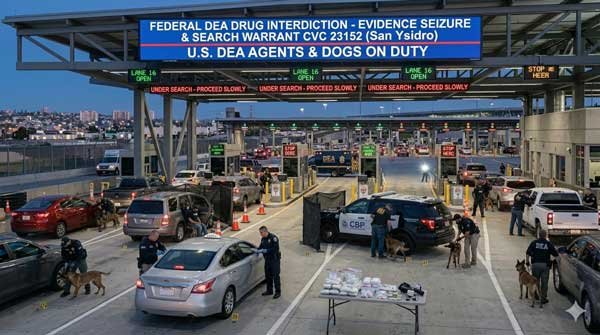
During a drug investigation search warrant, agents routinely seize everything of value — cash, jewelry, electronics, vehicles — regardless of whether those items are proven to be drug proceeds. Many seized items belong to innocent family members.
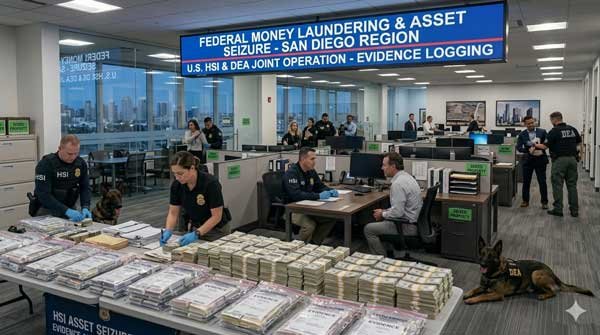
Federal agencies can freeze bank accounts, seize business assets, and take property in money laundering investigations — sometimes before any charges are filed. Business owners and cash-intensive industries like restaurants, retail, and import/export are frequently targeted.
People lose their money and property every day — not because the government was right, but because they made one of these mistakes. Read this carefully.
Agents on the scene may hand you a form and suggest that signing it will make things go faster, or that it is just a formality. It is not. Signing an abandonment form permanently and irrevocably surrenders your right to contest the seizure in any court.
This form is designed to look like the right move. It is not. Filing a petition for remission is an admission that the forfeiture was legally valid — it only asks the agency for "mercy." You lose all rights to a fair court hearing the moment you file it.
The government's notice of seizure looks like junk mail to many people. But inside that envelope is a deadline — often 30 to 35 days. Miss it by a single day and the government keeps your property, no questions asked, with no court hearing ever held.
Here is exactly what happens from the moment you call us to the moment your property is returned. No legal jargon — just a clear plan.
Call or text us the moment your property is seized or the moment you receive a government notice. We establish the timeline, identify the seizing agency, and determine which type of forfeiture you are facing — federal administrative, civil judicial, or state. Every hour counts.
We help you gather every document that establishes the legitimate source of your money or property — bank statements, business records, real estate closing documents, loan agreements, wire transfer records, and more. A strong paper trail often ends the case before it goes to court.
We file a Judicial Claim — not a petition for remission — which removes the case from the agency's hands and takes it into federal court where you have constitutional rights and a real hearing. This is the move the government does not want you to make.
We examine whether the seizure violated your Fourth Amendment rights (illegal search and seizure), whether there was sufficient probable cause, and whether law enforcement followed proper procedures. If the seizure was unlawful from the start, everything that followed is tainted.
In federal court, the government must prove their case — not just suspect it. Attorney Jason Ronis cross-examines agents, challenges probable cause, contests the "nexus" between your property and any alleged crime, and forces the government to justify their seizure under oath. Many cases are dismissed or settled here.
Jason Ronis Law has experience challenging forfeitures initiated by all major federal and local law enforcement agencies active in San Diego County.
The DEA is the most active federal forfeiture agency in San Diego. Drug raids, surveillance operations, and controlled purchases frequently result in mass property seizures — often targeting innocent family members.
FBI forfeitures in San Diego often involve money laundering, white collar crime, and organized crime investigations. Bank accounts, real estate, and business assets are the most commonly targeted property types.
CBP operates at San Ysidro, Otay Mesa, and Tecate — three of the busiest border crossings in the world. They seize vehicles and cash daily, often without sufficient evidence that the property was connected to any crime.
San Diego International Airport is a major corridor for cash seizures. TSA agents flag large sums; Homeland Security Investigations (HSI) follows up. Cash is seized from business owners, travelers, and families — often without any criminal evidence.
Local law enforcement seizes property under California's forfeiture laws during drug arrests, traffic stops, and search warrants. Under California's reformed forfeiture law (AB 1987), local agencies face stricter standards — and we know exactly how to challenge them.
The IRS and Financial Crimes Enforcement Network target cash-intensive businesses for "structuring" violations — making deposits under $10,000 to avoid reporting requirements. Bank accounts and business assets can be frozen without warning.
Asset forfeiture is a specialized area of law that combines civil procedure, federal criminal defense, and constitutional law. You need an attorney who has fought these cases — not one who will figure it out as they go.
J.D. 2003. Licensed by the California State Bar continuously since 2003. Member of the California Bar Association and American Bar Association.
Federal asset forfeiture cases are filed in federal court. Jason Ronis has practiced in the Southern District for over two decades — he knows the judges, the prosecutors, and the procedures that matter.
From seized cash at SAN Airport to vehicles taken at the San Ysidro border to cash swept up in DEA raids — Jason Ronis has a proven track record of getting property returned across Southern California.
Seizures happen at midnight, on weekends, and on holidays. So do we. Call or text (619) 859-2002 the moment you need help — a real attorney answers, not a voicemail.
These are real San Diego clients who felt blindsided, violated, and lost — until they called Jason Ronis Law.
When I was hit with an unexpected asset forfeiture issue, I felt completely blindsided and unsure of what to do. Jason Ronis and his team stepped in and immediately took control of the situation. They explained my rights clearly, broke down the legal process step by step, and fought hard to protect what was mine."
Asset forfeiture case · San Diego County Google Review ★★★★★
"When I found myself dealing with an asset forfeiture case, I felt completely lost. Jason Ronis and his team took the time to explain how the process worked and made sure I understood every option available. They were always available to answer my questions and made me feel heard and supported throughout."
Property seizure case · San Diego County Google Review ★★★★★
"Jason Ronis handled my case swiftly and effectively, achieving results that exceeded my expectations. I'm extremely grateful for his hard work and commitment. When I found myself in legal trouble, I was filled with anxiety and uncertainty about my future. From my very first call, Jason was incredibly knowledgeable, reassuring, and efficient."
Federal forfeiture case · Southern California Google Review ★★★★★
Straight answers. No legal jargon. No runaround. If you do not see your question here, call us — (619) 859-2002.
Yes — and this is exactly what makes civil asset forfeiture so alarming. Under both federal law and California law, the government can seize and permanently keep your cash, car, or property based solely on suspicion — without ever filing criminal charges against you, and without proving anything beyond a preponderance of evidence (just 51%). Attorney Jason Ronis challenges forfeitures at every stage, fighting to prove that your property was not connected to any criminal activity.
Federal administrative forfeiture deadlines are extremely strict. You typically have 30 to 35 days from the date the government mails its notice of seizure to file a claim. After that deadline passes, the government keeps your property automatically with no court hearing ever required. California state forfeiture timelines can differ. Call us immediately — do not wait until you “have more time.”
First: do not sign anything agents hand you — especially not an abandonment form or a petition for remission. Second: gather every document that proves where the money came from — bank withdrawal records, business receipts, a letter from the person who gave it to you. Third: call Jason Ronis Law at (619) 859-2002 immediately. Airport cash seizures in San Diego are some of the most winnable forfeiture cases — with the right attorney and the right documentation.
Yes, in many cases. CBP vehicle seizures at San Diego border crossings are challenged successfully when: the owner had no knowledge of any contraband, the search was unlawful, or CBP failed to follow proper seizure procedures. You must file a claim promptly — abandoning the vehicle or waiting past the deadline means losing it forever. Call us and we will review your border crossing case immediately.
This distinction is critical and it is where many people get hurt. A petition for remission is essentially asking the agency that seized your property to give it back as a favor. It admits the forfeiture was legally valid. You give up your right to a court hearing. A judicial claim contests the forfeiture in federal court — forcing the government to justify the seizure before a judge with real due process protections. Jason Ronis Law always recommends the judicial claim route, not the petition trap.
Absolutely — innocent third-party owners can contest forfeiture of their property. Under the “innocent owner defense,” if you can demonstrate that your property was not connected to criminal activity or that you had no knowledge of any illegal use of the property, you may be entitled to full return of your assets. This is a complex legal argument that requires experienced legal counsel — call Jason Ronis Law to discuss your situation.
No — and this is the most misunderstood aspect of asset forfeiture law. Under civil forfeiture, the government files a case against your property, not against you. You are not even a defendant. The government only needs to show that it is more likely than not (51%) that your property was connected to a crime. This is far below the criminal standard of “beyond a reasonable doubt.” California has stronger protections than federal law in some cases — an experienced San Diego forfeiture attorney can identify which rules apply to your situation.
Asset forfeiture cases in every city, courthouse, and federal district in San Diego County.
The government has powerful lawyers working to keep what they seized from you. You need an equally powerful attorney on your side — one who has done this before and won. Call Jason Ronis Law right now.
Consulta gratuita · Hablamos español · Confidential

We stand by your side in State and Federal courts, delivering proven results and round-the-clock emergency legal assistance.
Monday : Open 24 hrs
Tuesday : Open 24 hrs
Wednesday : Open 24 hrs
Thursday : Open 24 hrs
Friday : Open 24 hrs
Saturday : Open 24 hrs
Sunday : Open 24 hrs

